
Reserve Bank Governor Shaktikanta Das on Thursday said the central bank's asset purchases, aimed at mitigating COVID-19-related liquidity stress in the system, did not dilute its balance sheet or compromise on core principles of central banking. In the wake of the pandemic, the RBI undertook several conventional and unconventional measures. "Unlike many central banks, the RBI's asset purchases did not dilute its balance sheet and hence, did not compromise on core principles of central banking," Das said while addressing an event organised by the Bombay Chamber of Commerce. These purchases were confined to risk-free sovereign (government) bonds including state government securities only, he said.

The International Monetary Fund (IMF) on Tuesday slashed India's growth forecast for 2022-23 (FY23) by 80 basis points to 7.4 per cent, citing less favourable external conditions and rapid policy tightening by the central bank. In its update to the April World Economic Outlook, the IMF said that though a global recession in 2022 was ruled out with a growth estimate of 3.2 per cent, the balance of risks was squarely to the downside, driven by a wide range of factors that could adversely affect the global economic performance. "The risk of recession is particularly prominent in 2023, when in several economies growth is expected to bottom out, household savings accumulated during the pandemic will have declined, and even small shocks could cause economies to stall.
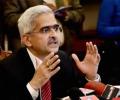
The Reserve Bank of India on Friday decided to leave benchmark interest rate unchanged at 4 per cent but maintained an accommodative stance as the economy faces heat of the second Covid wave.
Experts disagree with the idea and the Reserve Bank of India (RBI), which has the sole right to print money, is not comfortable with it as well.

As the Indian currency hovers around its lowest versus the US greenback, several smaller and mid-sized companies are expected to face rough weather as almost 44 per cent of the foreign loans taken by Indian companies remained unhedged. According to the data sourced from the Reserve Bank of India, Indian companies raised around $38.2 billion in the financial year ended in March. Of this, only 56 per cent of the loans are hedged while the rest of the foreign loans remain unhedged, thus risking the companies to forex volatility.
In a statement, the central bank said heightened volatility in capital markets in reaction to Covid-19 has imposed liquidity strains on mutual funds (MFs), which have intensified in the wake of redemption pressures related to closure of some debt MFs and potential contagious effects therefrom.

Finance Minister Nirmala Sitharaman has said the recent interest rate hike by the Reserve Bank was not surprising for her but the timing was, asserting that the rising cost of funds will not impact the government's planned infrastructure investments. For the first time since August 2018, RBI had on May 4 delivered a blunt 40 basis points increase in key repo rate to 4.40 per cent, and also hiked the cash reserve ratio by 50 basis points to 4.5 per cent after an unscheduled meeting of the rate setting panel, citing increased inflation pressures following the Ukraine war and the resultant spike in crude oil prices. Retail inflation printed at 6.9 per cent in March and the April reading is forecast to top 7.7 per cent.
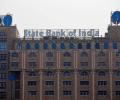
SBI is the third state-run lender to lower the lending rates after Indian Overseas Bank Tuesday and Bank of Maharashtra which also lowered their loan prices by 5 bps on loan tenors of one year and above, effective April 10.

Automobile retail sales in India increased by 37 per cent in April on a low base of COVID-hit April last year, automobile dealers' body FADA said on Thursday. Total sales across categories rose to 16,27,975 units in April, as compared to 11,87,771 units in the year-ago period. On a year-on-year basis, all vehicle categories including passenger vehicles and two-wheelers were up as compared with April last year.

'FDs should hold your emergency funds, equivalent to around 6-12 times your monthly expenses.'

At interactions last week with senior officials from the Reserve Bank of India, select banks gave feedback on two key bond market concerns, namely, recent volatility in the rupee-dollar exchange rate and heavy losses incurred on floating rate government bonds due to a demand-supply mismatch, sources told Business Standard. The discussions were held ahead of the RBI's next monetary policy statement, scheduled on August 5. Indian banks are large holders of government securities because of a regulatory mandate to set aside a certain percentage of deposits in sovereign bonds.

Consumer price inflation touched a nine-month high of 11.24 per cent last month.

'If the government spends Rs 10 lakh crore this year then you would be looking at a GDP growth of minus 5 per cent.' 'If you do not do this, you will be looking at GDP growth between minus nine and minus 10 per cent.'

The RBI has set up a panel to review ATM charges, and fees levied by banks.

All BSE sectoral indices ended in the red, with oil and gas, bankex, capital goods and finance falling up to 3.04 per cent.

A likely easing in inflationary pressures in the forthcoming months will reopen the window for the RBI to once again prioritise growth and ease its interest rates.

Oil marketing companies IOC, BPCL and HPCL have invited expressions of interest from start-ups that wish to be enrolled as fuel entrepreneurs for doorstep delivery of high-speed diesel through mobile petrol pumps.

RBI's liquidity tightening stance had stumped the Street as a result of which bond yields had risen.

Foreign investors have pulled over Rs 6,400 crore from the Indian equity market in the first four trading sessions of the ongoing month when the Reserve Bank of India (RBI) and US Federal Reserve raised interest rates. Given the headwinds in terms of elevated crude prices, inflation, tight monetary policy among others, FPIs' flows in India are expected to remain volatile in the near term, Shrikant Chouhan, Head - Equity Research (Retail), Kotak Securities, said. Foreign Portfolio Investors (FPIs) remained net sellers for seven months to April 2022, withdrawing a massive amount of over Rs 1.65 lakh crore from equities. This was largely on the back of anticipation of a rate hike by the US Federal Reserve and due to the deteriorating geopolitical environment following Russia's invasion of Ukraine.

Equities went into a tailspin on Wednesday after the Reserve Bank surprised the market with a mid-cycle rate hike in a bid to tame soaring inflation.

Housing sales jumped over 4.5 times year-on-year in April-June across eight cities to 74,330 units on lower base effect, while demand was up 5 per cent from the previous quarter, according to PropTiger data. Housing sales stood at 15,968 units in the April-June period last year and 70,623 units in the January-March quarter of 2022. The price of residential properties rose 5-9 per cent annually, driven by rise in input costs, inflationary pressures and premium attached with ready-to-move-in inventory. Pune and Chennai saw maximum appreciation at 9 per cent each.

The RBI's mistake may have been in interpreting its mandate to maintain retail inflation at 4%, with 2% leeway in either direction, as being a mandate that permitted it to do nothing even when inflation was at or near the upper bound of 6%, observes T N Ninan.

Rating agency Icra on Wednesday said while there is some evidence of the economic recovery becoming broad-based in the third quarter of fiscal 2022, it is yet to attain the durability being sought by the Monetary Policy Committee (MPC) as a precursor to policy transmission. The agency expects the real GDP to expand 6-6.5 per cent year-on-year in the third quarter of FY2022 (+8.4 per cent in Q2 FY2022). It also sees the RBI maintaining the status quo in the upcoming monetary policy review to be held in February.

You must remain invested in bank deposits, unless you are considering the idea of earning higher returns by moving to gilt or liquid funds, says Adhil Shetty, CEO, BankBazaar.com.

With no rate cuts on the table, the other monetary policy alternative could be to reduce the width of the asymmetric policy corridor or increase in reverse repo rate when the pandemic subsides, they opined.

The new rates vary from 8.80 to 9.05 per cent on various slabs of loans.

The wholesale price-based inflation in February rose to 13.11 per cent on hardening of prices of crude oil and non-food items, even though food articles softened. After two months of mild easing, WPI inflation accelerated in February and remained in double digits for the 11th consecutive month, beginning April 2021. WPI inflation last month was 12.96 per cent, while in February last year, it was 4.83 per cent. The rise in crude oil and natural gas prices after the Russian invasion of Ukraine, beginning February 24, has put pressure on the wholesale price index, even though food articles saw softening across categories of vegetables to pulses to protein-rich items.

'I don't see any major setback for the Indian markets post the US Fed event.'
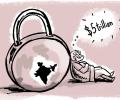
India is much better placed today to deal with future waves of the pandemic relative to the first wave, RBI deputy governor Michael Patra said.
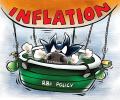
Reserve Bank on Wednesday said it expects retail inflation at 5.2 per cent in the first half of the current fiscal and revised downwards the target to 5 per cent for the quarter ended March. While headline inflation at 5 per cent in Feb 2021 remains within the tolerance band, some underline constituents are testing the upper tolerance level. Going forward, the food inflation trajectory will critically depend on the temporal and special progress of southwest monsoon in the 2021 season, RBI Governor Shaktikanta Das said on Wednesday while announcing the first monetary policy for the current fiscal. Reserve Bank of India (RBI) has kept the key repo rate unchanged at 4 per cent to support growth in the current situation.

Retail investors may safely invest in shorter-duration funds, suggests Sanjay Kumar Singh.

Fitch Solutions sees RBI keeping benchmark interest rates unchanged during the fiscal to March 2022 following its decision to buy Rs 1 lakh crore of government bonds. "We had initially expected another policy rate cut to arrest the rise in government bond yields since the Union Budget announcement in February. "However, having an explicit bond purchase guidance from the RBI following the announcement of the G-SAP will also achieve a similar effect, if not even be more effective than a rate cut on capping the increase in bond yields," it said in a note. The Reserve Bank of India (RBI) held its policy repurchase (repo) rate unchanged at 4 per cent at its monetary policy meeting on April 7.
The Reserve Bank of India on Tuesday hiked the cash reserve ratio by 25 basis points.

In case the repo rate keeps trending downwards, borrowers can expect a downward revision of their MCLR-linked loans.
Battling a sharp surge in inflation, the Reserve Bank is all for a smooth monetary policy response and the desire to have smaller hikes led it to tighten the policy in an off-schedule meet, a source said on Thursday. Inflation has been massively impacted by Russia's invasion of Ukraine and will in due course also reflect the dent caused by Indonesia banning palm oil exports, the source aware of central bank thinking said, indicating that there was no other option but to respond. "The idea is to have a smooth policy response, not to put in large cold turkey responses," the source said, making it clear that the preference is for smaller magnitude responses and not larger ones.

ICICI Bank was the top gainer in the Sensex pack, rising around 3 per cent, followed by Axis Bank, HDFC twins, SBI, L&T, ONGC and Infosys. On the other hand, Sun Pharma, Asian Paints, Nestle India, UltraTech Cement and HUL declined. NSE Nifty rose by 79.60 points or 0.67 per cent to 11,914.20.

The Governor said the MPC had voted to maintain its accommodative stance, implying more rate cuts in the future if the need arises.

'Three external members of the first MPC are respected researchers with excellent academic background, but there is no harm in considering academicians with diverse backgrounds such as finance and labour along with economists for this body,' recommends Tamal Bandyopadhyay.

Here are the highlights of the monetary policy announced by RBI governor Shaktikanta Das on Friday.

Wednesday's was the first MPC meeting that had a dissent note.
